
Introduction
Home should be the one place where your child’s nervous system gets to rest. For many autistic children, though, even home is full of hidden demands: the hum of the refrigerator, the overhead light in the kitchen, a sibling’s show playing in the next room, the scratch of a couch cushion. A sensory-friendly room gives your child a reliable place to reset, regulate, and simply be themselves.
You don’t need a finished basement, a therapy budget, or a Pinterest-perfect setup to build one. In our in-home ABA sessions across Maryland, some of the most effective calming spaces we see are a corner of a bedroom with a bean bag, a dimmer switch, and a basket of the right items. This guide walks you through how to plan a sensory-friendly room for your autistic child: what to put in it, what to skip, and how to make sure it actually gets used.
Why a Sensory-Friendly Room Matters for Autistic Children
Sensory processing differences are part of the diagnostic criteria for autism, and most autistic children experience the sensory world differently from their neurotypical peers, often in more than one direction at once. A child can be hypersensitive to some input (sounds feel louder, lights feel brighter, tags feel sharper) and hyposensitive to other input, actively seeking out crashing, spinning, squeezing, and deep pressure in order to feel grounded.
Neither pattern is misbehavior. When a child covers their ears, bolts from the dinner table, or melts down after holding it together through a long school day, their nervous system has usually been past its threshold for a while. A sensory-friendly room works on the front end of that curve. It gives your child a place to go before overwhelm peaks: a predictable environment where the input is filtered, familiar, and within their control.
There is a second benefit families sometimes miss. A well-designed space teaches self-regulation. A child who learns “when I feel like this, I go there and do that” is building one of the most valuable skills they will ever own, and it travels with them to school, to the grocery store, and eventually into adulthood.
Start With Your Child’s Sensory Profile, Not a Shopping List
The most common mistake we see families make is buying first and observing second. Sensory equipment only helps when it matches your child’s actual profile, and every autistic child’s profile is different. Before you order anything, spend a week or two watching:
- What does your child seek out? Squeezing into tight spaces, jumping on the couch, rubbing soft fabric, watching spinning objects, humming to themselves.
- What do they avoid or escape? Certain lights, appliance sounds, specific textures, visually busy rooms.
- Where do they naturally calm down? Under blankets, in a closet, in the bathtub, wrapped in a towel afterward.
- What happens right before hard moments? The pattern of what comes before a meltdown tells you which inputs to reduce and which supports to add.
Involve your child as much as you can. Depending on their age and communication style, that might mean offering a choice between two lamps, exploring textures together at the store, or simply noticing which items they return to again and again. A space chosen with a child gets used far more than a space assigned to them.
If your child already works with an occupational therapist or an ABA team, ask what they’ve noticed. In our sessions, the BCBA is often tracking exactly this kind of antecedent data already, and it maps directly onto how the room should be built.
Choosing the Right Spot in Your Home
A sensory-friendly space does not require a dedicated room. What it requires is consistency.
Good candidates include:
- A corner of your child’s bedroom, defined by a canopy, pop-up tent, or large floor cushion
- A closet nook with the door removed, and soft lighting added
- A section of a playroom or den separated by a low shelf or curtain
- An under-the-stairs spot or a wide window seat
Look for a location away from the loudest parts of the house, such as the kitchen, laundry, and main hallway. Then check the basics: cover outlets, anchor any furniture your child might climb, keep cords out of reach, and never use a door that locks from the inside. If your child is young or tends to elope, pick a spot where you can supervise without hovering.
The Key Elements of a Sensory-Friendly Room
Think of the areas below as dials rather than requirements. Your child’s profile tells you which ones to turn, and how far.
Lighting
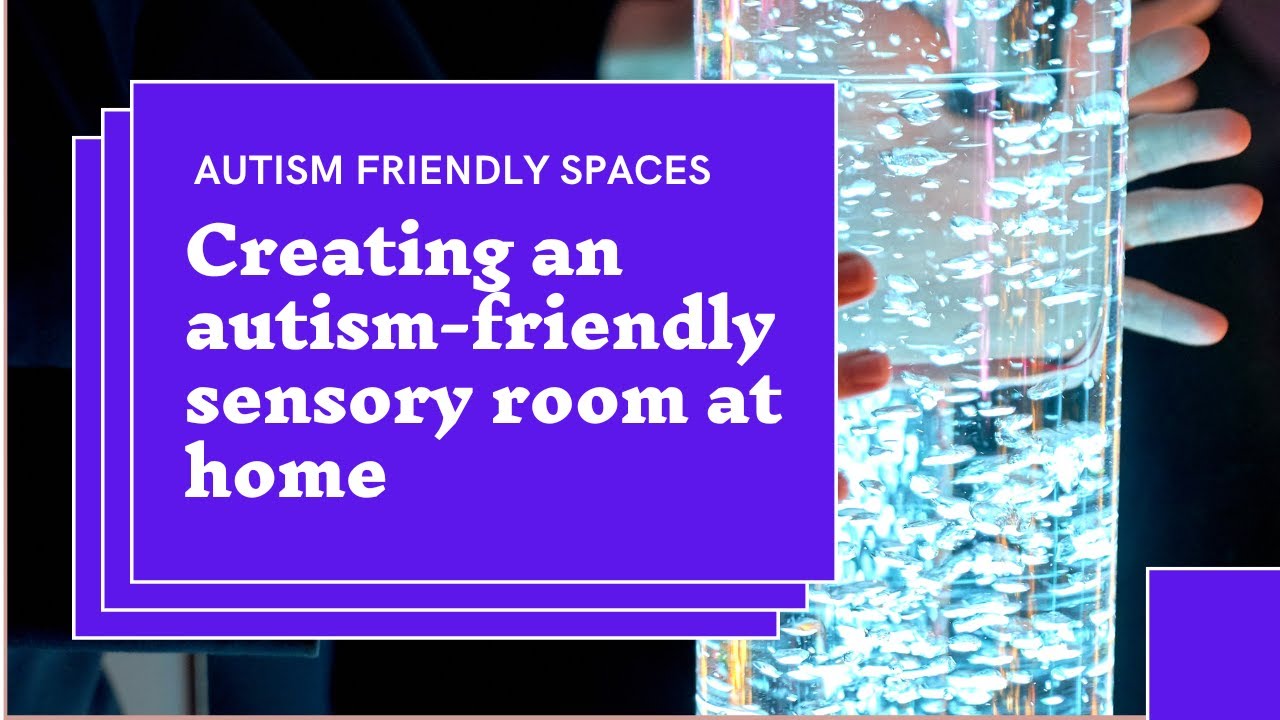
Harsh overhead lighting, especially fluorescent, is one of the most common hidden stressors for autistic children. Where you can, switch to warm, dimmable lamps and let your child control the level. Blackout curtains help light-sensitive children and also make visual sensory items stand out. For sensory seekers, slow-moving visual input such as a bubble tube, lava lamp, fiber optic strands, or a star projector can be deeply regulating to watch. Keep anything with a cord or a warm surface out of reach of younger children.
Sound
Soft surfaces are your friend here. A rug, floor cushions, heavy curtains, and a fabric canopy all absorb echo and noticeably lower a room’s ambient volume. A white noise machine or a small speaker playing your child’s preferred calming sounds gives them control over what they hear instead of what the house decides. For children with strong auditory sensitivity, ear defenders or headphones can be part of the toolkit as well; we cover how to choose and introduce them in our guide to noise-canceling headphones for autism.
Color and Visual Calm
Muted, low-arousal colors such as soft blues, greens, and warm neutrals are calming for many children, while bright reds and busy patterns tend to be activating. Matte finishes beat glossy ones, which create glare. Just as important as color is visual quiet: closed storage instead of open toy shelves, mostly bare walls instead of a gallery of posters, and one or two meaningful visuals rather than many. That said, your child’s preference wins. If deep purple is their safe color, use it.
Touch and Texture
Offer a small range of textures and let your child vote with their hands: a plush rug, a smooth beanbag, a fuzzy blanket, a basket of fidgets with different resistances. Pay equal attention to what you remove. If your child fights certain fabrics, itchy tags, or seams, keep those materials out of this space entirely. This should be the one room guaranteed free of the textures that cost your child energy.
Movement and Deep Pressure
Many autistic children regulate through proprioceptive input (the sense of pressure and body position) and vestibular input (the sense of movement and balance). Depending on your child, consider:
- A crash pad, a mattress on the floor, or a pile of large pillows for safe jumping and crashing
- A peapod, compression canoe, or body sock for full-body squeeze
- A small indoor swing or rocking chair for rhythmic movement (ceiling-mounted swings must be anchored into a joist, ideally by a professional)
- A weighted lap pad or weighted blanket for deep pressure
One important safety note on weighted items: a weighted blanket should be roughly ten percent of your child’s body weight or less. Your child must be able to remove it on their own, and weighted blankets are never safe for infants, toddlers, or any child who cannot free themselves. Use them for supervised calming time rather than overnight sleep unless your pediatrician or occupational therapist has advised otherwise.
Order and Predictability
Predictability is itself a sensory support. Closed bins with picture labels, a consistent home for every item, and a simple visual routine for the space (“shoes off, lights low, choose one bin”) lower the effort it takes to use it. Rotate items every few weeks instead of keeping everything out at once. A few available choices keep the space calming; a full inventory turns it back into clutter.
Building a Sensory-Friendly Room on a Budget
A regulated child is not a function of how much you spent. Some of the most-used calming spaces we walk into cost very little to put together:
- A pop-up tent or blanket fort as the enclosure
- Thrifted bean bags, couch cushions, or a spare crib mattress as the crash zone
- DIY sensory bottles made from water bottles, glitter glue, and beads
- An inexpensive dimmable lamp or a plug-in dimmer for one you already own
- Heavy blankets over a curtain rod standing in for blackout curtains
- Your local library, since some branches lend sensory kits or host sensory-friendly hours
Start with one or two supports matched to your child’s strongest need, watch for a couple of weeks, and build from there. Adding slowly also gives you honest data about what actually helps.
Common Mistakes to Avoid
Using the space as a time-out. The fastest way to ruin a sensory room is to send a child there as a consequence. The space has to remain somewhere your child chooses to go, or its calming power disappears.
Buying everything at once. A room stuffed with equipment is visually loud and confusing. More items means more stimulation, which is the opposite of the goal for most children.
Designing for a child you saw online. Bubble tubes and swings look wonderful in photos, but they only earn their place if they match your child’s profile.
Skipping the teaching. Using a calming space is a skill, not just a location. Practice going there together during calm moments, model the routine, and prompt it at the first signs of overload rather than at the peak of a meltdown. This is exactly the kind of routine we help families build in parent training.
Setting it and forgetting it. Sensory profiles shift as children grow. Revisit the room every few months, retire what gets ignored, and follow whatever your child gravitates toward now.
How In-Home ABA Therapy Fits In
Because our sessions happen where your child actually lives, our team sees the real environment, not a clinic version of it. During in-home ABA therapy, a BCBA can help you spot the antecedents that come before overload in your specific house, teach the “I need a break” communication skills that make the room genuinely useful, and fold the space into daily routines like homework and bedtime. For toddlers and preschoolers, this work often becomes part of an early intervention plan, when regulation skills are being built for the very first time. And if your child also sees an occupational therapist, we coordinate so the room, the therapy goals, and your daily routines all point in the same direction.
Conclusion
A sensory-friendly room is less a renovation project and more a listening project. Start with your child’s sensory profile, pick a consistent spot, and adjust the dials that matter for them: lighting, sound, color, texture, movement, and predictability. Keep it simple, keep it theirs, and never let it become a punishment. Built that way, even a humble corner with a lamp and a bean bag becomes something bigger than furniture. It becomes the place where your child learns that overwhelm has an exit, and that they know the way there.
Create a Calmer Home With Admire ABA
At Admire ABA, we help families build regulation skills right where daily life happens. Our team provides in-home ABA therapy, parent training, early intervention, daycare-based ABA, weekend sessions, and diagnostic services for families in Baltimore, Rockville, and Silver Spring, and throughout Maryland.
If you’d like help turning your child’s new space into lasting self-regulation skills, contact us today to schedule a consultation.
Frequently Asked Questions
What should I put in a sensory room for my autistic child?
Start with your child’s sensory profile, then add a few targeted supports rather than a full catalog: adjustable warm lighting, a soft place to land such as a crash pad or bean bag, one deep pressure item like a weighted lap pad, a small basket of preferred fidgets, and closed storage to keep visual clutter low. Add slowly and keep only what your child actually uses.
What colors are best for an autism-friendly room?
Muted, low-arousal colors such as soft blues, greens, and warm neutrals are calming for many autistic children, while bright reds, oranges, and busy patterns tend to be activating. Choose matte finishes to reduce glare. Your child’s preferences come first, though. If a specific color feels safe and soothing to them, that matters more than any general rule.
How much does it cost to create a sensory-friendly room at home?
It can cost very little. Many families start with a pop-up tent, a thrifted bean bag, a dimmable lamp, DIY sensory bottles, and blankets they already own, then add larger items like a peapod or indoor swing over time if their child responds well. Matching a few items to your child’s profile works better than buying a complete sensory kit upfront.
SOURCES:
- https://childmind.org/article/sensory-processing-issues-explained/
- https://childmind.org/article/treating-sensory-processing-issues/
- https://childmind.org/article/sensory-processing-faq/
- https://www.cdc.gov/autism/about/index.html
- https://www.mayoclinic.org/diseases-conditions/autism-spectrum-disorder/symptoms-causes/syc-20352928
- https://pathfindersforautism.org/