
Introduction
A child who can label colors during a therapy session but can’t identify the same colors at the grocery store hasn’t fully learned the skill yet. That gap between “can do it here” and “can do it anywhere” is exactly what generalization in ABA is designed to close. It’s one of the most important concepts in applied behavior analysis, and it’s also one of the most misunderstood, both by families new to therapy and by providers who don’t build it into treatment from day one.
What Generalization Means in Applied Behavior Analysis
Generalization refers to a learner’s ability to use a skill outside the exact conditions where it was originally taught, with different people, in different places, using different materials, and without needing the same prompts or reinforcement schedule that built the skill in the first place. A behavior that only shows up with one therapist, in one room, using one set of flashcards hasn’t generalized. It’s still confined to the training context.
This distinction matters because skill acquisition and skill generalization are not the same milestone. A child can master a target in eight out of ten trials with a BCBA and still be unable to use that same skill with a parent, a teacher, or a sibling. Progress notes that only track acquisition can look excellent while day-to-day functioning stays largely unchanged.
The Three Types of Generalization
Behavior analysts generally describe generalization in three interconnected forms:
- Stimulus generalization — applying a learned skill across different but related cues, people, or environments. A child who learns to follow “sit down” from a therapist should also follow it from a parent or teacher.
- Response generalization — using a variety of responses to accomplish the same functional goal. A child taught to request a break verbally should also be able to request it using a picture card or a gesture if speech isn’t available at the moment.}
- Maintenance — retaining a skill over time after direct teaching has been reduced or stopped, so the behavior doesn’t erode once formal instruction ends.
These three categories trace back to foundational behavior-analytic research. The influential 1977 paper on generalization technology described discrimination as historically treated as an active process with its own developed methods, while generalization was long treated as a passive byproduct rather than something practitioners actively engineer. That shift, from hoping generalization happens to deliberately programming for it, still shapes how quality ABA is delivered today.
Why Generalization Determines Whether ABA Progress Lasts
Parents enroll their child in ABA because they want change that shows up in daily life, not just on a data sheet. Generalization is the mechanism that makes that possible. Without it, a child can accumulate an impressive list of mastered goals that never translate into independence at home, cooperation at school, or comfort in the community.
The Risk of “Train and Hope”
One of the most common pitfalls in behavioral intervention is what’s sometimes called “train and hope,” teaching a skill in one context and simply assuming it will transfer everywhere else on its own. It sometimes does. Often it doesn’t. In our sessions, we’ve seen children master a self-help skill flawlessly at the clinic table, only to freeze when asked to do the same thing at the kitchen sink because the sink, the lighting, and the person asking are all unfamiliar variables. That’s not a failure of the child. It’s a sign the program needed a generalization plan built in from the start, not added as an afterthought.
How Behavior Analysts Build Generalization Into Treatment Plans
Effective generalization doesn’t happen by accident. Board Certified Behavior Analysts design for it intentionally, using a handful of proven strategies.
Teaching Across People, Places, and Materials
Rather than drilling a skill with the same instructor, in the same room, using the same objects every time, a well-designed ABA program deliberately varies who teaches the skill, where it’s taught, and what materials are used. A child learning to request a preferred item might practice with a BCBA, an RBT, and a parent, using different toys and different rooms in the home, so the skill isn’t accidentally tied to one narrow set of conditions.
Involving Parents and Caregivers
Generalization is far more likely to hold when the people who spend the most time with the child are actively part of the teaching process, not just observers of it. Standard ethical guidance for the field expects behavior analysts to identify everyone affected by a client’s treatment, including parents, caregivers, and other stakeholders, and to build their involvement into how services are delivered. In practice, this means parent training isn’t a separate add-on service. It’s a direct line to whether skills built in a session survive contact with real life.
Generalization Across ABA Service Settings
How generalization gets programmed looks a little different depending on where and how a child receives therapy.
In-Home ABA and Everyday Practice
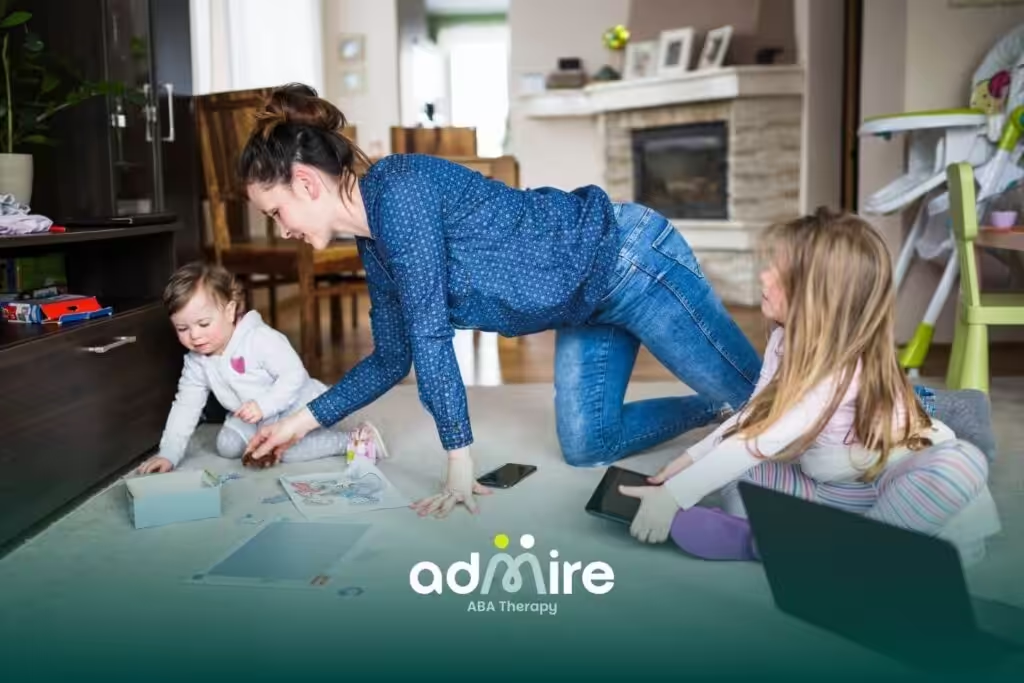
In-home ABA has a natural advantage for generalization because the “training environment” and the “real environment” are the same place. A skill practiced at the kitchen table during a session is already in the exact spot where it needs to happen every day. This is part of why in-home therapy tends to shorten the distance between what a child can do in session and what a family sees the rest of the week.
Daycare-Based and Weekend ABA
Daycare-based ABA introduces peer interaction and group routines that a clinic room or living room can’t fully replicate. A child who learns to wait for a turn one-on-one with a therapist still needs practice waiting for a turn next to three other toddlers reaching for the same toy. Weekend ABA offers a similar advantage for community-based skills, since weekend routines (errands, family outings, unstructured play) surface generalization opportunities that don’t come up during a typical weekday session.
Early Intervention and the Window for Skill Transfer
Generalization tends to happen more readily the earlier intervention starts, in part because young children haven’t yet built up rigid associations between a skill and one narrow context. Naturalistic behavioral approaches have shown particular promise with very young children, partly because they haven’t yet developed entrenched patterns that make skills harder to transfer. This is one of several reasons early intervention services are worth pursuing as soon as a delay is identified, rather than waiting.
Diagnostic services play a role here too. An accurate, early diagnosis is often the gateway to accessing early intervention programming, including Maryland’s state-run early intervention system for children under three, which families can access for eligible children without needing a formal autism diagnosis first.
Signs Generalization Isn’t Happening, and What to Do
A few patterns are worth flagging to your BCBA if you notice them:
- A skill only appears with one specific therapist and disappears with anyone else
- Progress reports show mastery, but you don’t see the behavior at home
- The child needs the exact same materials, phrasing, or setting every time to perform a skill
- A previously mastered skill fades once formal teaching on that target stops
None of these mean therapy has failed. They usually mean the treatment plan needs an explicit generalization component added, whether that’s more varied practice, more caregiver involvement, or a maintenance check-in schedule.
How Parents Can Support Generalization at Home
Families don’t need a behavior analysis degree to reinforce generalization between sessions. Practicing a target skill in more than one room of the house, asking a different family member to prompt it occasionally, and praising the skill wherever it shows up (not just when it was directly taught) all help a behavior take root outside the therapy setting. Parent training sessions exist specifically to walk caregivers through how to do this consistently and safely for the specific goals their child is working on.
Conclusion
Generalization is what turns a mastered ABA target into a functional, lifelong skill. It’s the difference between a child who can label colors on a flashcard and a child who notices the color of a stop sign on the way to school. Building generalization into a treatment plan from the beginning, across people, places, and materials, and with parents as active partners, is what separates ABA that produces paperwork progress from ABA that produces real change.
If you’re evaluating ABA options in Maryland and want a plan built with generalization in mind from day one, Admire ABA provides in-home, daycare-based, and early intervention ABA services across Maryland communities, including Towson in Baltimore, Germantown in Montgomery County, and Glen Burnie in Anne Arundel County.
Contact us today to schedule a diagnostic consultation or ask about parent training options for your family.
Frequently Asked Questions
What is generalization in ABA therapy?
Generalization in ABA is a child’s ability to use a skill learned in therapy across different people, places, and situations, and to keep using it over time without needing the exact same prompts that built it originally.
Why does my child perform a skill in therapy but not at home?
This usually means the skill has been acquired but hasn’t generalized yet. It’s a common, addressable stage in ABA progress, often resolved by practicing the skill with different people, in different settings, and involving parents directly in reinforcing it.
How long does it take for a skill to generalize in ABA?
There’s no fixed timeline; it depends on the skill’s complexity, how early intervention started, and how intentionally the treatment plan builds in varied practice. A BCBA should be actively planning for generalization, not just waiting for it to happen on its own.
SOURCES:
- https://pmc.ncbi.nlm.nih.gov/articles/PMC1311194/
- https://www.bacb.com/
- https://asatonline.org/research-treatment/research-synopses/generalization-of-pecs/
- https://pmc.ncbi.nlm.nih.gov/articles/PMC4513196/
- https://www.marylandpublicschools.org/programs/Pages/Special-Education/MITP/index.aspx
- https://www.cdc.gov/autism/data-research/